 Contact Us
Passivhaus
Passivhaus
With more clients striving to achieve net zero carbon goals, Passivhaus provides a proven, reliable framework for designing and upgrading buildings that can meet these future carbon targets.
With more clients striving to achieve net zero carbon goals, Passivhaus provides a proven, reliable framework for designing and upgrading buildings that can meet these future carbon targets.
Passivhaus is one of the most rigorous and proven standards for energy efficiency, designed to dramatically reduce carbon emissions while delivering exceptional indoor comfort with minimal heating and cooling. It places a strong emphasis on the performance of the building envelope and requires close attention to detail throughout design and construction to meet its criteria which is measured and verified through PHPP software. Our in-house Certified Passivhaus Designer, can support clients in creating and upgrading buildings that not only meet the Passivhaus energy and comfort targets, but also provide long-term resilience, efficiency, and wellbeing.
These design principles must be integrated from the outset, as they are essential for ensuring the building meets the Passivhaus performance criteria:

Passivhaus Design Principals
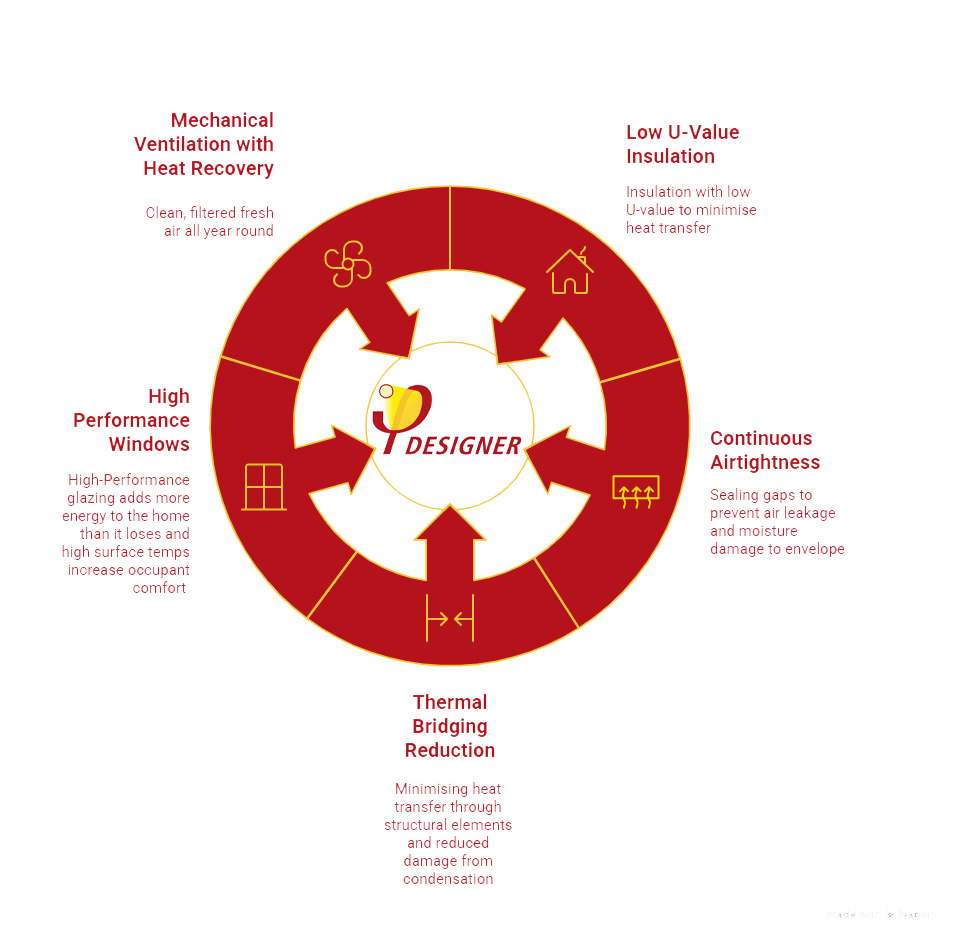
Passivhaus design is founded on fundamental principles that must form part of an performance-led approach, as outlined in the diagram below, that prioritises comfort, energy efficiency, and long-term building quality.
While these principles are essential to achieving certified Passivhaus standards, they are equally valuable when applied selectively to projects without formal Passivhaus ambitions. This approach brings meticulous attention to detail across both design and construction, resulting in improved fabric performance, enhanced airtightness, and greater durability. By applying these principles where appropriate, we are able to deliver projects that achieve measurable improvements in energy efficiency, comfort, and build quality, regardless of whether full Passivhaus certification is pursued.
Passivhaus design is founded on fundamental principles that must form part of an performance-led approach, as outlined in the diagram below, that prioritises comfort, energy efficiency, and long-term building quality.
While these principles are essential to achieving certified Passivhaus standards, they are equally valuable when applied selectively to projects without formal Passivhaus ambitions. This approach brings meticulous attention to detail across both design and construction, resulting in improved fabric performance, enhanced airtightness, and greater durability. By applying these principles where appropriate, we are able to deliver projects that achieve measurable improvements in energy efficiency, comfort, and build quality, regardless of whether full Passivhaus certification is pursued.
Benefits of the Passivhaus Standard:
There are many interconnected benefits to the Passivhaus approach. While its exceptional energy efficiency and thermal performance are often the main focus, the standard’s equally important emphasis on comfort and indoor air quality ensures it delivers positive outcomes for both people and the planet.
Building Performance – Demand reduction sits at the core of the Passivhaus standard. By relying on the building’s inherent thermal stability, it requires only minimal input from the heating system. This approach optimises the project for Net Zero operation and aligns it with the future capacity of our decarbonised grid.
Achieving this level of performance depends on meticulous attention to detail throughout both design and construction. It requires higher-quality components and a robust airtight layer that significantly protects the building fabric. The result is a final project that delivers superior energy performance and a markedly higher standard of construction quality.
Climate Emergency – In the face of climate emergency, decarbonisation is a critical part of our response. Passivhaus enables the levels of demand reduction that we need to achieve Net Zero goals.
Health and Wellbeing – The Passivhaus standard prioritises health and comfort, creating indoor environments that actively support occupant wellbeing. This is achieved in part by eliminating cold buildings and their associated health impacts, but also through construction methods that deliver excellent indoor air quality, reducing pollutants and ensuring consistent, effective ventilation.
Financial – Passivhaus projects offer a range of financial benefits. They are significantly more affordable to run, with reduced energy use and lower maintenance costs.
Benefits of the Passivhaus Standard:
There are many interconnected benefits to the Passivhaus approach. While its exceptional energy efficiency and thermal performance are often the main focus, the standard’s equally important emphasis on comfort and indoor air quality ensures it delivers positive outcomes for both people and the planet.
Building Performance – Demand reduction sits at the core of the Passivhaus standard. By relying on the building’s inherent thermal stability, it requires only minimal input from the heating system. This approach optimises the project for Net Zero operation and aligns it with the future capacity of our decarbonised grid.
Achieving this level of performance depends on meticulous attention to detail throughout both design and construction. It requires higher-quality components and a robust airtight layer that significantly protects the building fabric. The result is a final building that delivers superior energy performance and a markedly higher standard of construction quality.
Climate Emergency – In the face of climate emergency, decarbonisation is a critical part of our response. Passivhaus enables the levels of demand reduction that we need to achieve Net Zero goals.
Health and Wellbeing – The Passivhaus standard prioritises health and comfort, creating indoor environments that actively support occupant wellbeing. This is achieved in part by eliminating cold buildings and their associated health impacts, but also through construction methods that deliver excellent indoor air quality, reducing pollutants and ensuring consistent, effective ventilation.
Operation Efficiency – The operation of Passivhaus buildings is extremely efficient as the design and approach drastically reduces energy demand through a high-performance building fabric, excellent airtightness, and heat recovery ventilation. This results in lower running costs, more predictable energy use, and more efficient building operation over the long term.
Related Projects

Our architectural services are bespoke to your project and will include exploring your building procurement options and which route best suits your project-specific needs.
We frequently collaborate with our supply chain partners to bring you the highest possible levels of service and are proud of our reputation for being responsive and inclusive. Equally, we have a reputation for working alongside our clients’ preferred consultants and supply chain partners and will work with you to build a strong team environment.